



The Endocannabinoid System (ECS): The Science Behind Balance, Wellness, and CBD
Last Updated: July 2026
This article has been updated to reflect the latest research on the Endocannabinoid System (ECS), CBD, and advances in medical education.
Understanding the Remarkable System That Helps Keep Your Body in Balance
If you've ever wondered how CBD actually works, the answer begins with one of the most fascinating, and least understood, systems in the human body: the Endocannabinoid System, often called the ECS.
While many people have heard of CBD, surprisingly few have heard of the remarkable system that allows cannabinoids to interact with the body in the first place. Even more surprising, the Endocannabinoid System wasn't discovered until the late 1980s and early 1990s, making it one of the newest major physiological systems identified by modern science.
What You'll Learn in This Guide
In this guide, you'll discover:
- What the Endocannabinoid System (ECS) is and why it's essential for overall wellness.
- How the ECS helps your body maintain balance (homeostasis) every day.
- The roles of endocannabinoids, CB1 and CB2 receptors, and the enzymes that keep the system functioning properly.
- Why CBD doesn't work like THC, and what makes it such a unique wellness companion.
- What the latest research says about the ECS, healthy aging, and cellular wellness.
- Simple lifestyle habits that may help support a healthy Endocannabinoid System.
- Answers to common questions about the ECS and cannabinoid science.

Today, researchers recognize the ECS as one of the body's primary regulatory networks. Its job isn't to control just one organ or one function. Instead, it helps coordinate communication throughout the body, working behind the scenes to maintain stability, adaptability, and balance, what scientists call homeostasis.
Whether you're sleeping, exercising, recovering from a busy day, managing everyday stress, or simply going about your daily routine, your Endocannabinoid System is constantly working to help your body adapt to changing conditions.
As research continues to expand, scientists are discovering that the ECS may influence an impressive range of normal physiological processes, including:
- Sleep quality
- Mood and emotional well-being
- Memory and learning
- Appetite
- Healthy inflammatory responses
- Immune system communication
- Stress resilience
- Exercise recovery
- Energy metabolism
- Overall cellular balance
It's no wonder researchers around the world are devoting increasing attention to understanding this remarkable system.
Why the Endocannabinoid System Matters More Than Ever
Over the last decade, interest in the Endocannabinoid System has grown dramatically.
Scientists studying neuroscience, immunology, metabolism, aging, exercise physiology, and even gastroenterology have all begun investigating how the ECS helps maintain healthy function throughout the body.
In fact, there are now tens of thousands of published scientific papers exploring cannabinoids, endocannabinoids, cannabinoid receptors, and the many ways this system helps support normal physiology.
Despite this growing body of research, many people, including healthcare professionals, are only beginning to learn about the ECS.
For years, medical education focused primarily on familiar body systems like the nervous system, cardiovascular system, digestive system, and immune system. The ECS received relatively little attention, largely because it was discovered much later than these other systems and because cannabis research faced significant legal and regulatory challenges for decades.
Fortunately, that landscape is beginning to change.
Medical educators are increasingly recognizing the importance of teaching future healthcare professionals about the Endocannabinoid System. Recent educational initiatives have proposed incorporating ECS science into medical training, reflecting the growing appreciation for its role in maintaining overall health and balance.
Understanding the ECS doesn't simply help explain how CBD works, it also provides a fascinating window into how the human body constantly works to keep itself in equilibrium.
What Is the Endocannabinoid System?
The Endocannabinoid System is a sophisticated communication network found throughout nearly every part of your body.
Unlike the cardiovascular system, which transports blood, or the digestive system, which processes food, the ECS acts more like a master coordinator. It helps different systems communicate with one another so your body can respond appropriately to whatever life throws your way.
Think of the ECS as your body's internal balancing system.
Every day your body encounters countless changes:
- Physical activity
- Emotional stress
- Poor sleep
- Changes in diet
- Environmental factors
- Everyday wear and tear
Your body is constantly making small adjustments to maintain stability despite these challenges. The Endocannabinoid System helps coordinate many of these adjustments by sending signals between cells and organ systems, supporting your body's natural ability to maintain balance.
Scientists refer to this balancing process as homeostasis.
Homeostasis doesn't mean everything stays exactly the same. Instead, it means your body continually adapts to changing circumstances while keeping important biological processes within healthy operating ranges.
You can think of it much like a thermostat in your home. When the temperature drifts too high or too low, the thermostat makes small adjustments to restore comfort. Similarly, the Endocannabinoid System is continually helping your body respond and adapt to everyday changes, promoting overall balance and resilience.
This remarkable communication network extends throughout the brain, nervous system, immune system, digestive tract, skin, muscles, connective tissues, and many other organs, illustrating just how important it is to overall wellness.
In the next section, we'll explore the three key components that make the Endocannabinoid System work: the body's own endocannabinoids, cannabinoid receptors, and the specialized enzymes that help keep everything in balance.
Meet the Three Parts of the Endocannabinoid System
The Endocannabinoid System may sound complex, but it's built around three simple components that work together continuously to help your body maintain balance.
Think of the ECS as a communication network. Messages are constantly being sent throughout your body, and the ECS helps ensure those messages are delivered at the right time and in the right place.

The three essential components are:
- Endocannabinoids – your body's own naturally produced messenger molecules
- Cannabinoid Receptors – specialized receptors that receive those messages
- Enzymes – the cleanup crew that breaks down endocannabinoids once their job is finished
Let's take a closer look at each one.
Endocannabinoids: Your Body's Natural Messengers
One of the most fascinating discoveries about the ECS is that your body naturally produces compounds that closely resemble cannabinoids found in the hemp plant.
These compounds are called endocannabinoids.
Unlike hormones that are stored until they're needed, endocannabinoids are produced on demand whenever your body needs them.
They act like tiny messengers, helping cells communicate with one another so your body can respond appropriately to everyday challenges.
Researchers have identified several endocannabinoids, but two are especially important:
Anandamide (AEA)
Often called the "bliss molecule," anandamide was the first endocannabinoid discovered.
Its name comes from the Sanskrit word ananda, meaning joy or bliss.
Scientists believe anandamide plays an important role in supporting normal mood, motivation, learning, memory, appetite, and stress adaptation.
Your body produces anandamide naturally, and then quickly breaks it down after it has delivered its message.
2-Arachidonoylglycerol (2-AG)
The second major endocannabinoid is called 2-AG.
Although it's less well known than anandamide, it's actually found in much higher concentrations throughout the body.
Researchers believe 2-AG plays an important role in healthy immune communication, nervous system signaling, and maintaining overall physiological balance.
Together, anandamide and 2-AG help your body constantly adapt to changing conditions.
Cannabinoid Receptors: Receiving the Message
Once endocannabinoids are produced, they need somewhere to deliver their message.
That's where cannabinoid receptors come in.
These receptors act like tiny docking stations located on the surface of cells throughout the body.
When an endocannabinoid binds to a receptor, it signals the cell to respond appropriately.
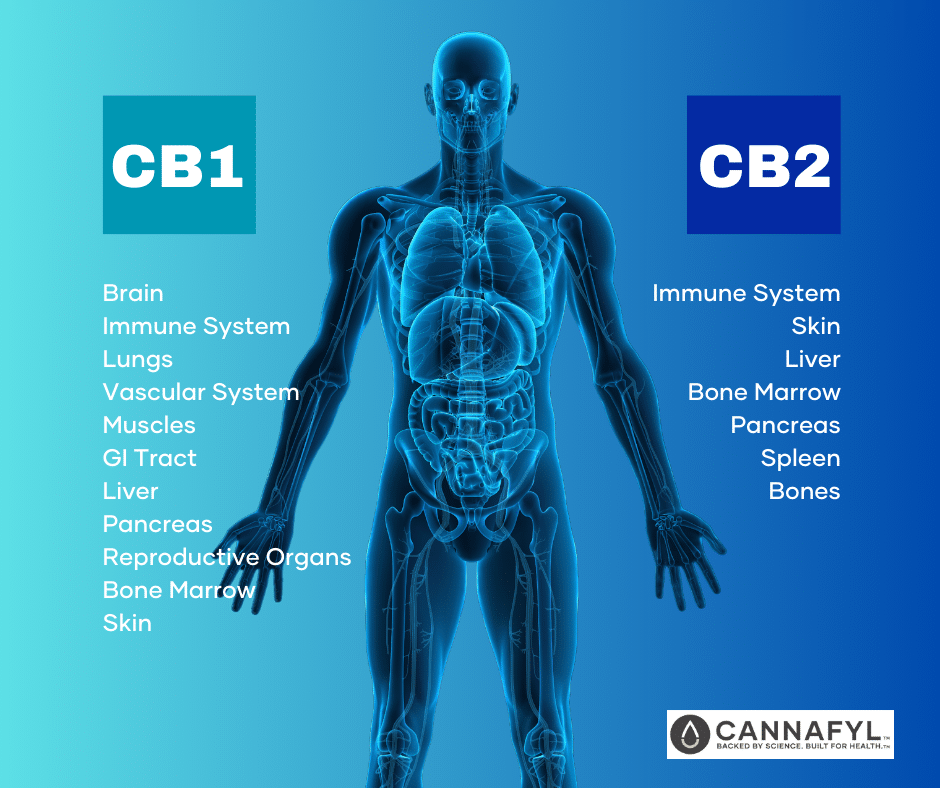
Scientists have identified two primary cannabinoid receptors.
CB1 Receptors
CB1 receptors are found primarily throughout the:
- Brain
- Central nervous system
- Peripheral nerves
Because of their location, CB1 receptors help regulate many normal neurological processes, including:
- Mood
- Memory
- Learning
- Appetite
- Sleep
- Pain perception
- Motor control
These receptors are also responsible for the psychoactive effects associated with THC.
CB2 Receptors
CB2 receptors are found primarily throughout:
- The immune system
- Peripheral tissues
- Skin
- Bones
- Digestive tract
Rather than affecting mood or perception, CB2 receptors are more closely associated with maintaining healthy immune function and supporting the body's normal inflammatory response.
Scientists continue discovering CB2 receptors in additional tissues, highlighting how widespread the ECS truly is.
It's More Than Just CB1 and CB2
One exciting development over the past several years is that researchers now understand the Endocannabinoid System is even more sophisticated than originally believed.
While CB1 and CB2 remain the primary cannabinoid receptors, CBD also appears to influence several other receptor systems involved in normal body function.
These include receptors associated with:
- Healthy stress responses
- Temperature regulation
- Healthy inflammatory signaling
- Cellular communication
- Nervous system balance
Scientists are actively studying these interactions, helping explain why CBD's effects are often described as broad and supportive rather than targeting just one system.
This growing understanding is one reason research into cannabinoids continues to expand worldwide.
Enzymes: Knowing When the Job Is Done
Once an endocannabinoid has delivered its message, your body needs to remove it so the system is ready for the next signal.
That's the job of specialized enzymes.
Two enzymes are especially important:
FAAH (Fatty Acid Amide Hydrolase)
FAAH breaks down anandamide.
Because anandamide is often associated with feelings of well-being, researchers have become especially interested in understanding how FAAH influences overall ECS activity.
MAGL (Monoacylglycerol Lipase)
MAGL breaks down 2-AG after it has completed its signaling function.
Together, these enzymes help prevent overstimulation and keep the ECS functioning efficiently.
How CBD Supports the Endocannabinoid System
One of the biggest misconceptions about CBD is that it simply attaches to cannabinoid receptors like THC.
In reality, CBD works quite differently.

Instead of strongly binding to CB1 receptors, CBD appears to support the Endocannabinoid System in several indirect ways.
Research suggests CBD may:
- Help maintain healthy endocannabinoid activity
- Influence enzymes involved in endocannabinoid metabolism
- Support communication between cells
- Interact with multiple receptor systems involved in maintaining balance
Rather than forcing the body in one direction, CBD is often described as a modulator, helping the ECS respond appropriately to changing conditions.
This is one reason CBD doesn't produce the intoxicating effects associated with THC.
Instead, many people describe CBD as supporting a sense of balance, calm, and overall well-being.
CBD and THC: What's the Difference?
Although CBD and THC are both cannabinoids found in hemp and cannabis plants, they interact with the body differently.
THC binds directly to CB1 receptors in the brain, which produces the euphoric or intoxicating effects commonly associated with cannabis.
CBD, on the other hand, has very little direct activity at CB1 receptors.

Instead, it appears to work alongside the body's own Endocannabinoid System, supporting its normal communication pathways without causing intoxication.
This distinction is one reason many people choose full-spectrum hemp-derived CBD products as part of their daily wellness routine.
When used as directed, federally legal hemp-derived CBD products contain less than 0.3% THC by dry weight, allowing users to benefit from the plant's naturally occurring compounds while remaining within federal guidelines.
Why Scientists Are So Excited About the ECS
The Endocannabinoid System influences so many aspects of human physiology that researchers often describe it as one of the body's master regulatory systems.
As scientists continue learning more about the ECS, they're uncovering new connections between this remarkable network and healthy aging, exercise recovery, metabolism, immune communication, stress resilience, sleep quality, and overall wellness.
Perhaps the most exciting discovery isn't that the ECS controls one thing exceptionally well, it's that it helps many different systems work together more efficiently.
What Scientists Are Discovering Today
The Endocannabinoid System has become one of the fastest-growing areas of research in modern physiology.
Every year, scientists learn more about how this remarkable communication network helps the body adapt to everyday challenges and maintain balance.
Current research is exploring how the ECS may influence many aspects of normal human physiology, including:
- Healthy aging
- Exercise recovery
- Sleep quality
- Stress resilience
- Gut-brain communication
- Metabolic function
- Immune system communication
- Skin health
- Cellular energy production
Rather than focusing on a single organ or system, researchers now recognize that the ECS serves as a communication bridge connecting many of the body's major physiological systems.
This expanding understanding is helping scientists better appreciate why maintaining a healthy Endocannabinoid System may be an important part of supporting overall wellness.
The ECS and Healthy Aging
One particularly exciting area of research involves the relationship between the Endocannabinoid System and healthy aging.
As we grow older, our bodies naturally experience changes in cellular communication, energy production, and resilience. Researchers are investigating how the ECS may help support the body's ability to adapt to these changes over time.
One area receiving increased attention is the connection between the ECS and mitochondria, the tiny structures inside nearly every cell that produce the energy our bodies need to function.

Often called the "powerhouses of the cell," mitochondria convert nutrients into the energy that fuels everything from muscle movement to brain function.
Emerging evidence suggests that cannabinoid signaling may play a role in supporting normal mitochondrial communication and cellular energy balance. While research is still evolving, scientists are actively exploring how the ECS contributes to maintaining healthy cellular function throughout the aging process.
This is one reason the Endocannabinoid System has become an important topic in healthy aging research.
Why You're Hearing More About the ECS
If the Endocannabinoid System is so important, why haven't more people heard about it?
The answer is surprisingly simple.
The ECS wasn't discovered until the late 1980s and early 1990s, making it one of the newest major physiological systems identified by modern science.
Because cannabis research faced decades of legal and regulatory barriers, scientific progress moved much more slowly than research involving many other body systems.
As a result, the ECS was never fully incorporated into many traditional medical school curricula.
Fortunately, that's beginning to change.
In 2025, medical educators published a proposed framework of core competencies for future physicians that includes understanding the Endocannabinoid System and cannabinoid science. Organizations dedicated to ECS education continue working with healthcare professionals to improve awareness and encourage evidence-based education.
While widespread curriculum changes take time, this represents an important milestone.
The conversation is evolving from "What is the ECS?" to "How can understanding the ECS improve patient education and wellness?"
That shift is exciting for healthcare professionals, researchers, and individuals interested in taking a more informed approach to their health.
Real-World Progress
Recently, one of our longtime Cannafyl customers shared an experience that beautifully illustrates how attitudes toward cannabinoids continue to evolve.
"I was in the hospital for a few days for a couple of issues. As always, they asked what medications and supplements I take. I told them I take one prescription thyroid medication, several supplements, and CBD and THC at night. When I was discharged, my paperwork included CBD and THC on the list of what I take. I was so happy to see this coming from doctors. Ten years ago, you would never have seen that."
Stories like this remind us that meaningful change often happens gradually.
While every healthcare provider has different levels of experience with cannabinoid science, many are becoming increasingly familiar with the Endocannabinoid System and the growing body of research surrounding it.
Open conversations between patients and healthcare professionals help ensure everyone has the information needed to make informed wellness decisions.
Supporting Your Endocannabinoid System Naturally
Although researchers continue studying the ECS, several healthy lifestyle habits are known to support overall wellness and may also help support normal Endocannabinoid System function.

Stay Active
Regular, moderate exercise has been shown to stimulate the body's natural production of endocannabinoids.
Whether it's walking, strength training, yoga, swimming, or cycling, consistent movement helps support overall health while naturally engaging the ECS.
Eat Healthy Fats
Omega-3 fatty acids serve as important building blocks for the body's natural endocannabinoids.
Foods such as salmon, walnuts, chia seeds, flaxseed, and other healthy fats can help support normal endocannabinoid production as part of a balanced diet.
Prioritize Restful Sleep
Sleep is one of the body's most important recovery tools.
Maintaining healthy sleep habits supports numerous physiological systems, including those involved in stress adaptation, recovery, and overall balance.
Manage Everyday Stress
Practices like meditation, deep breathing, spending time outdoors, journaling, and mindfulness can all support emotional well-being and healthy stress management.
Many people also incorporate CBD into their daily wellness routine as part of a balanced lifestyle.
Choose High-Quality CBD
Not all CBD products are created equal.
When selecting a CBD product, look for companies that provide:
- Third-party laboratory testing
- Transparent ingredient lists
- Clearly labeled cannabinoid content
- Hemp sourced from reputable growers
- Quality manufacturing standards
At Cannafyl, we believe quality, transparency, and education should always go hand in hand.
Looking Ahead
The Endocannabinoid System is no longer one of science's best-kept secrets.
As research continues and medical education evolves, more people are discovering just how remarkable this system truly is.
At Cannafyl, our mission has always been simple:
To educate, inspire, and provide high-quality full-spectrum CBD products that support your body's natural ability to maintain balance.
The more we understand the Endocannabinoid System, the more we appreciate the incredible wisdom already built into the human body.
We look forward to sharing the latest research as new discoveries continue to emerge.
Frequently Asked Questions
Does everyone have an Endocannabinoid System?
Yes. Every person naturally has an Endocannabinoid System. It begins developing before birth and continues supporting normal physiological function throughout life.
Does CBD replace my body's endocannabinoids?
No.
CBD does not replace your body's naturally produced endocannabinoids. Instead, research suggests it may help support the Endocannabinoid System's normal communication processes.
Does CBD bind to cannabinoid receptors the same way THC does?
No.
THC binds directly to CB1 receptors, producing intoxicating effects.
CBD works differently and appears to support the ECS through several indirect mechanisms without producing intoxication.
Is research on the Endocannabinoid System still ongoing?
Absolutely.
Scientists around the world continue investigating how the ECS influences healthy aging, exercise recovery, sleep, metabolism, immune communication, stress resilience, and many other aspects of normal physiology.
Why are doctors just beginning to learn about the ECS?
The ECS is one of the newest major physiological systems discovered. Because research expanded rapidly only in recent decades, medical education is still catching up.
Recent initiatives are encouraging greater inclusion of ECS science in healthcare training.
Continue Learning
Interested in learning more?
Read our companion article:
Why Doctors Are Finally Paying Attention to the Endocannabinoid System
You'll discover how medical schools are beginning to include ECS education and why researchers believe this remarkable system deserves much greater attention.
Scientific References
- JAMA Network Open. Developing Medical Cannabis Competencies. 2025.
- International Journal of Molecular Sciences. The Endocannabinoid System in Human Disease. 2025.
- Frontiers in Pharmacology. Cannabinoids and the Endocannabinoid System in Health and Disease. 2025.
- Journal of Cannabis Research. Professional Needs Regarding Cannabis and the Endocannabinoid System. 2025. (updated)
- National Center for Biotechnology Information (NCBI). Endocannabinoid System research archive.
- Society of Cannabis Clinicians.
- ECS.education.
Explore our full line of full-spectrum CBD products thoughtfully crafted to help you feel the difference from within.
These statements have not been evaluated by the Food and Drug Administration.
-
Posted in
benefits of cbd, cannabinoids, ecs, full spectrum cbd






:%20The%20Science%20Behind%20Balance,%20Wellness,%20and%20CBD)